
Resilient Future Studio: beauty and resilience can coexist

The False Dichotomy Between Beauty and Resilience
Editor’s note: This case study highlights the work of KC Coyne and Resilient Future Studio. Coyne will be a featured presenter during the placemaking portion of Scenic Symposium 2026, Scenic America’s biennial gathering of advocates, urban and regional planners, designers, and community leaders who are interested in scenic conservation. The Symposium will take place Sept. 23–24 at the Missouri Botanical Garden in St. Louis. Registration is open for this event.
To reach Coyne at Resilient Future Studio: KC@resilientfuturestudio.com, www.ResilientFutureStudio.com
Resilient Future Studio
In discussions of urban planning, there is a false belief that resilience and visual beauty cannot coexist. At Resilient Future Studio, KC Coyne works to dispel those myths. KC and I (Tziporah Feldman) serendipitously met in Houston, Texas, at a local coffee shop. Hearing buzzwords like resilience, ecology, and planning, I knew I had to admit that I was eavesdropping and introduce myself.
KC, founder of Resilient Future Studio (RFS), is an ecologist and urban planner based in Austin, Texas. RFS is an urban design and planning consultancy with expertise in resilience, sustainable design, parks and open spaces, public health, and green infrastructure that integrates ecological principles. The practice is rooted in embracing communities in placemaking design. Before founding RFS, KC served as the environmental officer for the City of Austin, an assistant director over the city’s Watershed Protection Department, and a co‑leader of one of Austin’s most ambitious community‑centered resilience plans.
KC and RFS are challenging the belief that natural ecological processes and urban beautification are incompatible. For example, across the country, people may automatically picture manicured grass and nonnative ornamental trees when asked to picture a scenic public park. Yet that view can be limiting, not only in terms of a lack of appreciation for beauty in different forms but also, perhaps even more importantly, in terms of wasted opportunities to heal our ecosystems.
Of course, ecological beauty is not instant. Like many of the best design plans, it requires patience. For example, Austin has worked to better steward riparian zones along creeks. While the standard design for most urban areas may require nothing but grass to the creek’s edge, the riparian zone can instead be used as a grow zone for native species. Along the way, the process gets messy while the system is healing itself. But with sufficient time and careful management of ecological succession, the result is a more functional riparian system that provides significantly greater benefits to both people and ecosystems.
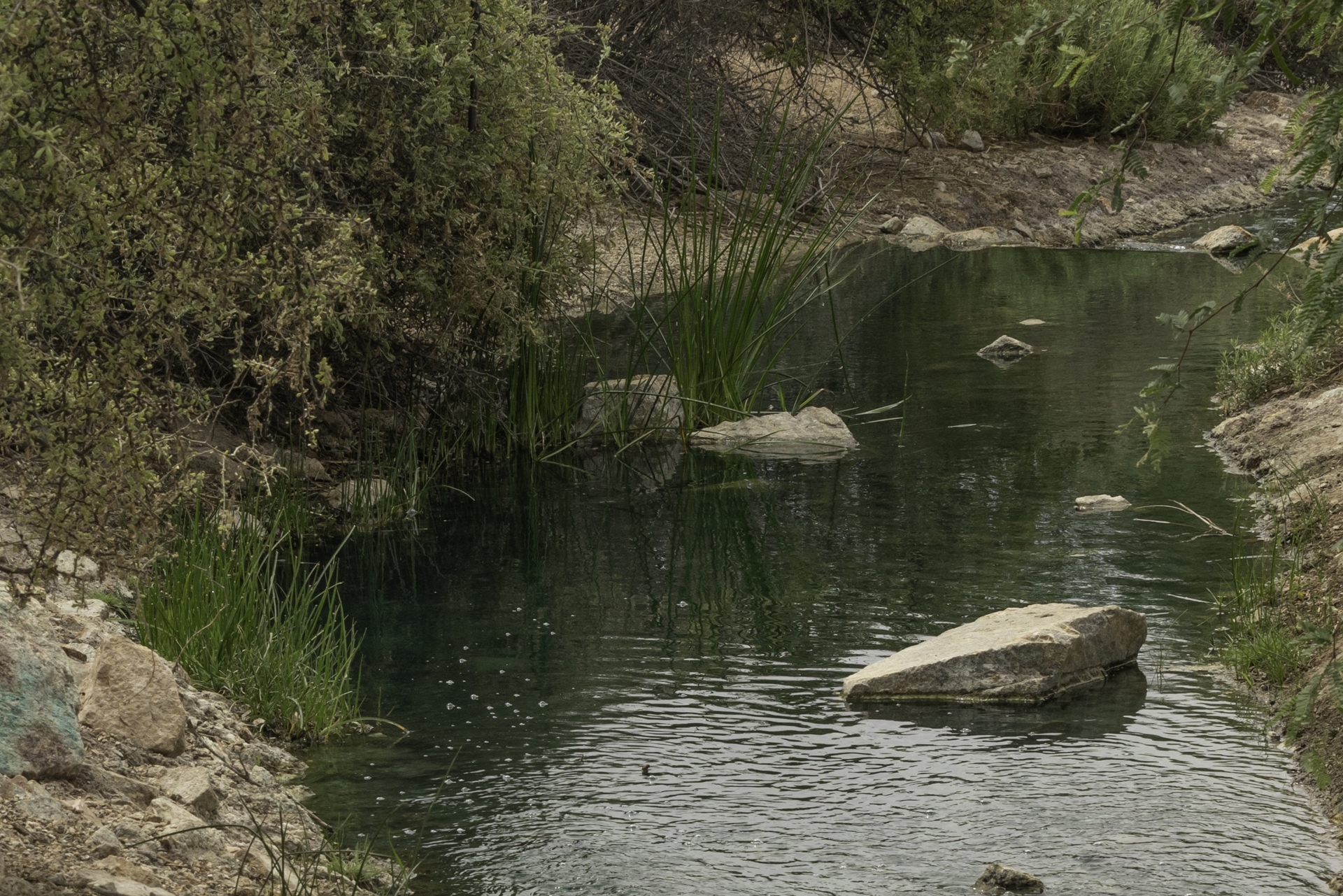
Allowed to flourish undisturbed, riparian zones such as this support native species of flora and fauna, improving the ecosystem, water quality, resistance to erosion, and visual appeal. Photo by Bloodberry on Shutterstock.
While some investment in public engagement must occur when the system is still “messy,” including shifting the narrative around “dangerous” wildlife associated with less manicured places, the advantages of increasing a neighborhood’s green index can be profound. These include improvements to habitat and water quality, reductions in heat‑island effects, increased property values, and mental health benefits for the community.
In this case study, Resilient Future Studio and Scenic America join forces to demonstrate how conservation, resilient infrastructure, and scenic character can all work together to create cohesive, context‑sensitive placemaking.
Mexican wrestling matches: participatory research for placemaking
For any placemaking project, it’s imperative to have a participatory lens to understand the needs of the community. For the Pasadena Healthy Parks Plan (completed in KC’s time at Houston‑based firm Asakura Robinson in collaboration with Land & Water Connections Consulting), KC’s team took an immersive approach, going to events ranging from senior center socials to Mexican wrestling matches to engage with the Pasadena community.
The community input was robust: 1,043 individuals responded to the community survey; 400 were reached through a demographically representative telephone poll; 45 community members of all ages attended an in‑person Community Workshop; 79 separate accounts logged in to participate in an online workshop; 790 people were reached through community events; 42 comments were posted on the project’s Interactive Map; 21 local leaders and experts participated in interviews; and 43 Advisory Committee members participated in planning meetings. This participation was necessary to identify health disparities, environmental risk, and access to parks across different neighborhoods.
For Scenic America’s supporters, the results of this data collection may be unsurprising: Pasadena’s parks are one of the greatest contributors to positive quality of life. Community members noted a need for “more natural beautification” in Pasadena Parks, pointing out that natural features, abundant shade trees, and the presence of wildlife are among the most important aspects of any park.
The plan includes a science‑based parks design toolkit with six sections: Move, Relax, Gather, Cool Off, Breathe, and Support Nature. Together they describe parks where people can move their bodies, find safety and quiet, connect with neighbors, escape the heat, breathe clean air, and experience the natural world. Furthermore, the plan addresses place‑based risk factors, including medical conditions such as asthma, mental health issues, obesity, cholesterol, and high blood pressure; socioeconomic factors including income and houses without cars; and environmental factors like heat islands. These are the same values that underpin Scenic America’s work across the country: a belief that access to parks is not a luxury, but an essential factor for public well‑being.
This participatory lens follows in RFS’s recent engagement in the Rio Grande Valley in Texas. The University of Texas, as part of its Planet Texas 2050 program in collaboration with Pharr Youth Eco‑Alliance and ARISE Adelante, is demonstrating the importance of community collaboration when designing greenspaces. This participatory work is particularly groundbreaking — a product of five years’ worth of conversations among planners, researchers, and community members, with a specific focus on young people’s interests. This has led to designs to improve Jones Box Park, a critical park asset with a longstanding lack of investment, in a way that will increase the park’s beauty, community access to quality recreation space, and ecological value in an area with a burgeoning ecotourism industry.
Placemaking in the face of resilience challenges
As cities face hotter summers, stronger storms, and the growing demands of urban life, design has to wear increasingly more hats: solve technical problems, prevent and mitigate disasters, and upgrade aging infrastructure to support larger populations, all while improving the environment and maintaining scenic beauty to ensure places are livable for humans and wildlife alike.
Resilient Future Studio approaches this challenge through design that blends infrastructure, ecology, and identity.
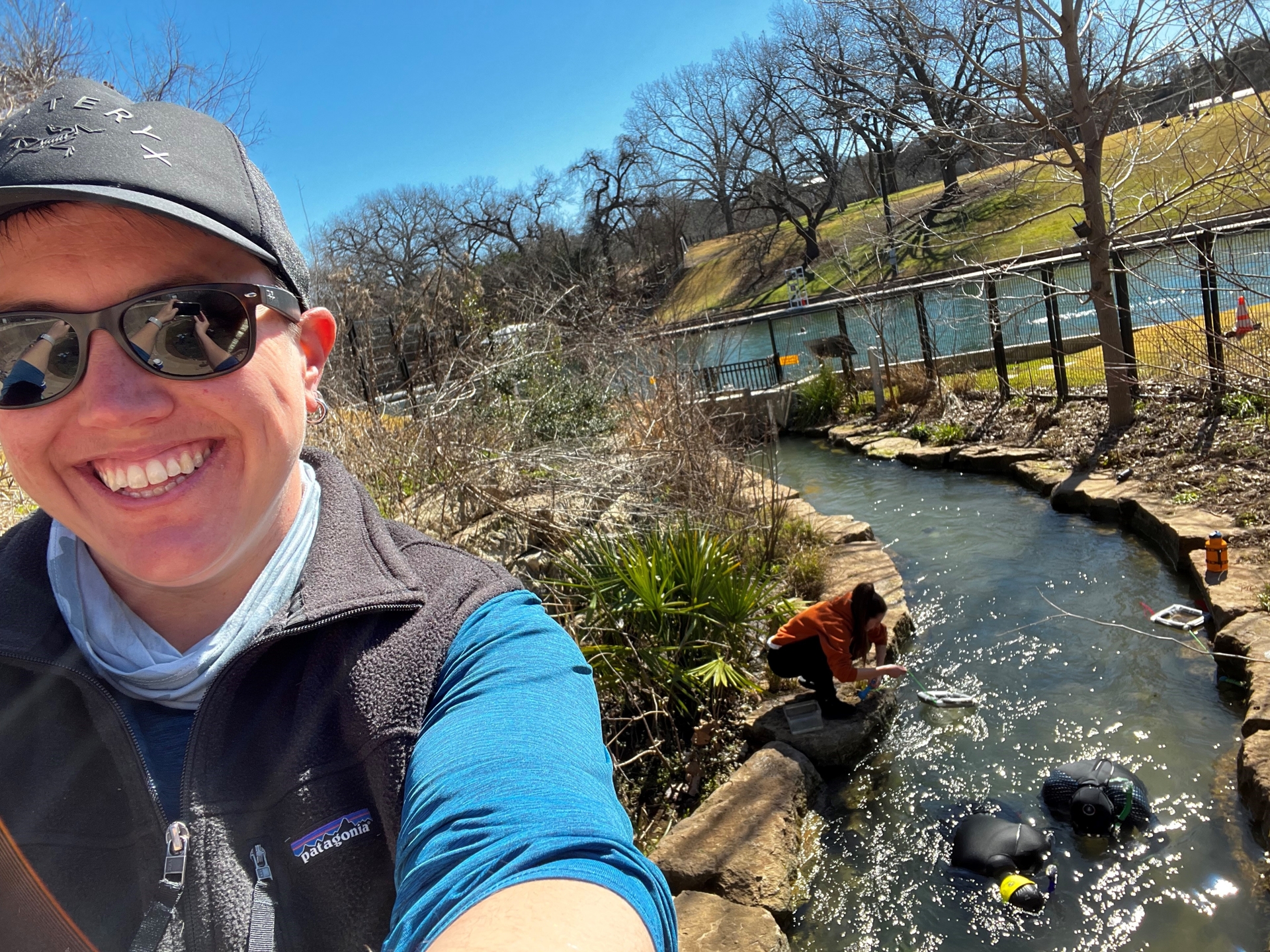
Coyne is all smiles as members of their team study water quality as part of a project in Austin, Texas.
Photo c/o RFS.
Much like how Scenic America’s work centers on the tangible aesthetic benefits of nature, RFS highlights ecosystem services as a whole, or the benefits humans receive from nature — especially when nature is stewarded well. In Austin’s community resilience plan, the concept of “Natural Systems” is identified as one of its key strategies for resilience. The plan pursues four major goals:
- By 2030, legally protect an additional 20,000 acres of natural lands and manage all new and existing natural areas (approximately 70,000 acres total), focusing on resilience.
- By 2030, protect 500,000 acres of farmland from development in the five‑county region through legal protections or regenerative agriculture programs.
- Achieve at least 50% citywide tree canopy cover by 2050, focusing on increasing canopy cover.
- By 2030, include all city‑owned lands under a management plan that maximizes community co‑benefits.
To achieve these goals, the plan lays out specific strategies that directly overlap with Scenic America’s mission, including protecting natural areas and farmlands, managing natural lands for resilience while including local ecological knowledge, protecting existing canopy cover and expanding tree protections, and encouraging green infrastructure in underutilized public spaces. Centering natural systems in city planning shifts the dialogue away from nature as a separate entity and instead promotes the view that nature is an integral public asset that reduces urban heat, manages stormwater, and improves mental and physical health.
Similarly, a goal of Resilient Houston — Houston’s first resilience plan (completed in KC’s time at Asakura Robinson) — highlights the following strategies:
- Make Houston neighborhoods greener and cooler to combat extreme heat through a focus on urban heat‑island mapping, tree planting, prairie restoration, cool and green roofs, cool pavement, and shade structures.
- Develop “lily pads” to serve as Neighborhood Resilience Hubs containing emergency supplies and recovery support.
- Ensure all neighborhoods have access to quality parks and nature by enhancing existing parks, investing in parks throughout the city, and using nontraditional lands such as schools as parks.
- Grow access to quality food to nourish Houston’s status as a culinary capital.
- Prevent, mitigate, and recover from the effects of environmental challenges in our communities, emphasizing land‑use policy, clean air, and clean drinking water.
Beauty and infrastructure
While Scenic America would like to see all overhead lines put underground for resilience and visual pollution reduction, we recognize that process won’t happen overnight. As part of RFS’s work to develop an action plan for the new University of Houston Institute for Ecological Resilience, KC has facilitated numerous conversations about innovative nature‑based solutions for the region. Many Houston‑based partners are working toward transforming transmission easements into greenways, wetlands, and walking paths. These corridors, once converted, will manage stormwater, provide shade, and offer recreational space, showing that even the most functional parts of a city can support both people and wildlife.
In urban areas, KC notes that undergrounding utility lines can be tricky because of underground “spaghetti” infrastructure involving multiple underground utilities and inconsistent local laws and standards. Additionally, because of clearance requirements, design standards for utilities, stormwater, and wastewater systems often conflict with tree‑planting or habitat goals, and there’s little consensus among utility departments on how to safely co‑locate these elements, despite practical design solutions being available. In Austin, for example, even those who support sustainable infrastructure have raised concerns about liability: under current rules, property owners could be responsible for street trees they may be mandated to plant near underground utilities. The result is that undergrounding, while potentially reducing overhead visual pollution, can impede tree canopy, heat island, greenspace, and resilience goals without further attention to mitigating design conflicts.
Ecology as beauty
Cities are typically viewed as separate from nature. Rarely will you hear someone proclaiming they are visiting a major city to immerse themselves in nature. KC approaches their work by rejecting the false dichotomy between cities and nature — affirming that the two are not inherently at odds. And perhaps a focus on creating wildlife‑ and nature‑friendly cities can complement and enhance scenic beauty.
Challenging traditional views on community design and what makes a place beautiful and livable, RFS believes that “nature” belongs inside the city, not pushed to its edges. For example, the South‑Central Waterfront Vision Plan (completed in KC’s time at Asakura Robinson) in Austin reimagines the city’s waterfront as a living system where restored creek corridors, native plantings, and shaded pedestrian networks create both scenic beauty and ecological function. Instead of hiding water infrastructure, the plan celebrates it, turning stormwater channels into linear parks and habitat zones. Green facades, removal of huge parking structures, green space on complete streets, green rooftops, and pocket parks are all feasible ways to reintroduce ecological communities into our human communities.
RFS extends that philosophy through planning and code reform, asking how cities can make green infrastructure the rule, not the exception. In Austin, flooding and water quality are central to public priorities, driving changes to the land‑use code mandating that green infrastructure be included in most new development. In 2022, under KC’s leadership, the city changed its ordinance (20221027‑045) to require green stormwater controls, which may include nature‑based infrastructure like biofiltration ponds and rain gardens, for sites with less than 90% impervious cover. Cities are also experimenting with decentralized systems: clusters of smaller‑scale water‑cleaning features integrated throughout neighborhoods rather than a centralized control tucked out of sight. These distributed systems not only improve water quality and urban cooling but also bring nature back into daily life.
The same lesson applies to flood infrastructure: levees and detention basins are usually treated as afterthoughts that are functional but devoid of natural beauty. But RFS points to places like Willow Waterhole Greenway in Houston, where flood‑control basins are also parks, wildlife habitat, and beloved neighborhood spaces. Willow Waterhole Greenway has a series of detention basins where trails and endangered plant restoration areas are integrated throughout. At Gene Green Park, a park designed to flood rather than a basin designed to also be a park, areas are designed to flood in a high‑intensity rain event perhaps a few times a year, but serve a core recreational purpose the rest of the time.
Beauty for the sake of joy
In recent memory, design and planning have often focused on finding the most convenient and cost‑effective solution. Beauty and art in design have been seen as an “extra” component, a “nice‑to‑have” but only to be added if there’s extra room in the budget. Yet nationwide there has been resistance to the idea that beautification practices are not a requirement. A focus on “practical” solutions to environmental degradation misses the mark on the needs of the human heart to not only be safe but also see beauty and feel joy and awe — with widespread consequences to a community’s mental and physical health.
The practice of making art is even beginning to be seen as an important community‑building action. Work to address environmental challenges is often framed through policies, infrastructure projects, technical studies, and implementation plans, but lasting change also depends on culture, imagination, and relationships. Community‑produced zines, artwork, poetry, and storytelling serve as critical complements to more traditional planning efforts by translating complex ideas into accessible expressions and community voices that people can see themselves in. Art creates space for reflection, healing, and collective visioning, helping residents connect environmental challenges to their lived experiences while strengthening trust, participation, and shared ownership of solutions. As the Austin plan itself recognizes, transformative change happens not only through institutions and investments but also through culture, creativity, and the relationships that bind communities together.
Even on a federal level, there is positive momentum for integrating beauty into this work. The mission of the U.S. Department of Transportation’s Beautifying Transportation Infrastructure Council is to enhance and improve the aesthetic value of the country’s transportation systems. Inherent in its mission is the belief that beautification needs to be integrated into the process of design. Cities across the country are beginning to follow suit, recognizing that beautiful public spaces generate community pride, encourage stewardship, and draw people outside in ways that concrete jungles and signs never could.
Scenic America and Resilient Future Studio are united in the belief that beauty and art should remain integral parts of society because they bring joy and fuel human hearts. The places communities build shape the lives they live. A more resilient future must both heal the land and be a more beautiful and joyful one.