
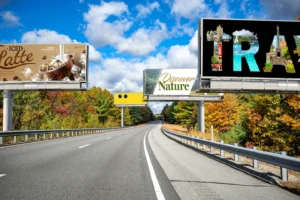
About those billboards…Ryan Huddle \ Globe staff; Adobe stock
BILLY BAKER
Why haven’t we banned highway billboards in Massachusetts? (Like Maine and Vermont.)
Ever notice how Vermont and Maine feel visually pristine? That’s partly because of what’s not there.
In October, I had the privilege of taking long drives through the northern New England states during the height of fall foliage. Maine was spectacular. Vermont was just showing off.
Yet it was in New Hampshire, home to perhaps the most stunning geography in New England, that I asked myself why that state felt . . . different. Less visually pristine than its neighbors, even when the vistas said otherwise.
Nothing against New Hampshire, as the feeling only got worse when I crossed the line back into Massachusetts. But I still couldn’t put my finger on what it was.
Then, suddenly, it smacked me in the face, in the form of a personal injury lawyer pointing at me and telling me to call him. And a marijuana dispensary promising they had the kindest buds. And a car dealership shouting about its low, low prices.
Before we continue, please try to picture the following four states: Hawaii, Alaska, Vermont, and Maine.
Like what you see? Of course you do. They’re crisp and scenic and share one important thing in common. They are the only states that have outlawed a polluting industry.
They’ve banned billboards.

A billboard in Revere. David L. Ryan/Globe Staff
Known variously as off-premises advertising or outdoor advertising, billboards are a blight that has somehow become normalized, been granted extraordinary powers we don’t give to brick-and-mortar businesses, and allowed to evolve into digital displays that are even better at taking drivers’ eyes off the road.
They’re unavoidable. They’re gross. And the states that banned them are kinda laughing at the rest of us.
“When we do surveys of travelers and ask: ‘What did you like most about Vermont?’ the most common No. 1 is the lack of billboards,” said John Kessler, chair of the Travel Information Council in Vermont, which passed legislation banning billboards in 1968 and inspired Maine to do the same a decade later. (The bans in Hawaii and Alaska predate their becoming states, though in 1998 Alaska voters overwhelmingly approved a measure tightening the restrictions further.)
I’m not the only one who wants them gone. Scenic America, a nonprofit in Washington, D.C., has been gaining momentum for billboard bans for decades and is at war with Big Billboard.
When I emailed Scenic America asking how I go about getting these things out of my sight, I received a call from the group’s president, Mark Falzone, and nearly dropped the phone when he said, “I’m from Saugus.”
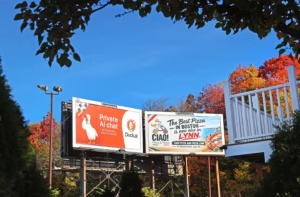
Multiple billboards in Revere exist near a rear deck on an apartment. David L. Ryan/Globe Staff
If you are unfamiliar with Route 1 in Saugus, or only remember it from its roadside Americana days, know that it is absolutely polluted with billboard blight. Falzone knows this all too well, because he was the state representative for Saugus and surrounding communities for a decade. When he took the job at Scenic America in 2017, he said, it was because “it feels like it was written for me.”
First, he warned me that if I’m against billboards, I’m up against a multibillion-dollar industry, led by three large companies — Lamar, Clear Channel, and OUTFRONT Media — who together control about a quarter-million billboards.
Second, he apologized for what was happening to me. “Your life is now ruined. You’ll never unsee a billboard again,” he said. “And whatever you do, don’t start looking at overhead wires and asking why that can’t be underground.” (Utility cables are another issue Scenic America works on.)
And he said his job is fielding queries from people all over the country who have had a realization like mine. “You wondered why Maine and Vermont felt more special than New Hampshire. What’s the dissonance? You realized it. Most don’t. But everyone who has that realization comes to the same conclusion: We don’t want this anymore.”

A billboard near Norwood Street in Dorchester next to the Expressway on Nov. 3. David L. Ryan/Globe Staff
And don’t get him started on the Out of Home Advertising Association of America, the main trade group for the billboard industry, and that group’s studies that claim billboards don’t affect drivers. “Their very purpose is to take eyes off the road and onto their product, but they claim it’s not a distraction,” said Falzone, who argued the danger has only increased in the era of constantly changing digital billboards. “There’s no commonsense argument for it.”
I reached out to an OAAA spokesperson and told her I was working on a story about how billboards were a blight that visually pollutes our environment. She asked if I had any specific questions, and I said I wanted to give them the chance to make the argument for billboards. I never heard back.
On its website, Scenic America makes available sample legislation, modeled on language used by Hawaii, Alaska, Vermont, and Maine, that has withstood repeated challenges from the billboard industry, on how to achieve a statewide ban on off-premises billboards (all four states still allow businesses to advertise on their property).
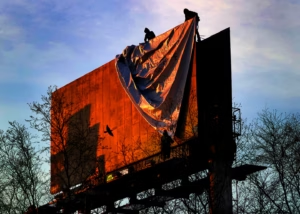
Workers changed a billboard during sunrise in East Boston in 2023.David L. Ryan/Globe Staff
Falzone said it can be done via the legislature or a ballot measure, and works by banning new billboards and making existing billboards noncompliant. To compensate the owners of existing billboards for the loss of business, you use an amortization process, where they’re allowed to keep the billboard up for a number of years, and the revenue they earn during that period replaces the money the state would need to pay them.
“The billboard industry hates amortization and has tried to pass laws to disallow the practice,” Falzone said. “But it works, and it may take a number of years, but eventually they’ll all be gone.”
In 2007, Oregon put a cap on the number of billboards, meaning an existing one must come down for a new one to go up. And there is constant movement at the local level, and an estimated 700 communities around the world have banned them, including São Paulo, Brazil, in 2006, and Grenoble, France, in 2014. In 2002, San Francisco banned any new billboards and has since passed increased restrictions targeting many forms of outdoor advertising.
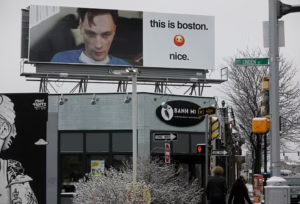
A billboard advertising the game of GeoGuessr was placed at Brighton Avenue and Linden Street, in Allston in 2023.Pat Greenhouse/Globe Staff
There’s momentum here, which is stupendous. But Falzone threw a curveball at me when he said we don’t want all outdoor advertising gone. Because sometimes that big, in-your-face advertising is part of what he called placemaking, which he defined as “when you arrive in a place, you know you’re there.” Times Square was mentioned. As was the Las Vegas Strip (though many of those are on-premises signs). And finally, yes, Route 1 in Saugus.
Big advertising is part of the Saugus identity, he said, from the orange dinosaur and giant cactus that are remnants of its heyday, to the big billboards of today. “If you took a picture, would you know you’re there?” he asked.
You would. So I concede that sometimes billboards fit their surroundings. I can’t imagine Fenway Park without the big Citgo sign. But most of the time, billboards destroy their surroundings and make every town look like Anyplace USA.
I’m kind of sorry that I ever noticed. Apologies if I’ve now ruined it for you. Let’s just agree to ignore the overhead wires.
For now.
Billy Baker can be reached at billy.baker@globe.com. Follow him on Instagram @billy_baker.
Visit The Boston Globe